SCOTLAND
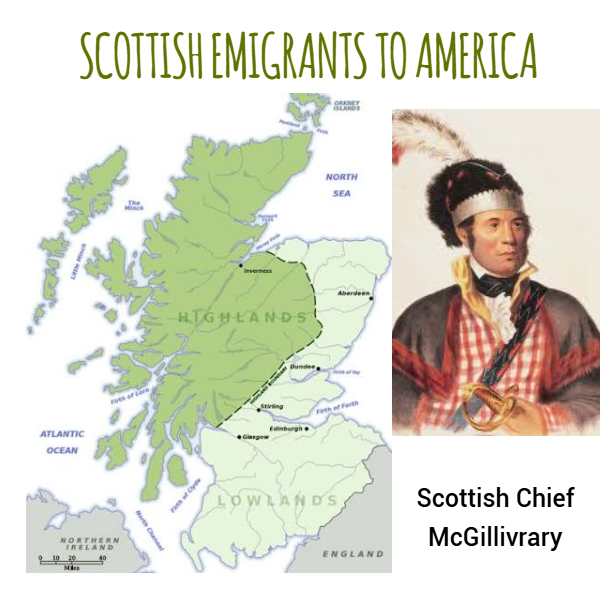
From Scotland to America
Notice: The term “Scotch” has been used since the 16th century as a reference to persons in Scotland. Thus, the term " Scotch-Irish" was used to differentiate that persons were born in Scotland, yet were residents of Northern Ireland. Wikipedia’s reference to " Scots-Irish " is a foolish error. The purpose of this information is to assist the genealogist in finding more information about the ancestors. The sources are varied, from written books to information in a vast collection of personal files.
The Ulster Scots
The single most important fact to learn while tracing Scottish families is the difference between the Scotch and the Scotch-Irish. Ancestors from Scotland migrated to America from Ulster and/or the Highlands. Ancestors were Scotch-Irish if they were Presbyterians and left Scotland, moving to Northern Ireland before sailing to America.
Scottish emigration to America came in two streams — one direct from the motherland and the other through the province of Ulster in the north of Ireland.
Collections of georgiapioneers.com
1. The Scots Peerage, Wood's Edition of St. Robert Douglas' Peerage of Scotland, Vols 1-9
2. Scottish Heraldry made easy
3. A History of the Highlands, and the Highland Clans, Vols. 1-4
Northern Ireland
Throughout their residence in Ireland, Scottish settlers preserved their distinctive Scottish characteristics, and generally described themselves as the Scottish nation in northern Ireland. Upon immigration to America, they remained as distinct from the native population as if they had never crossed the channel.
Notably, the Scotch-Irish settled in the Blue Ridge Mountains of North Carolina. One cannot assume that the migrants to America were uneducated. Young men were sent to the University of Glasgow and, as residents of America, signed the matriculation register as " A Scot of Ireland."
Another interesting effect is that the Scottish population did not intermarry with the native Irish, though they did intermarry to some extent with the English Puritans and French Huguenots.*
Ireland is indebted to the Huguenots for its lace industry. Many Irish-American writers on the Scottish Plantation of Ulster have assumed that its settlers were entirely or almost of Gaelic origin. Yet, upon settling in America, the early Scots retained an unmixed National Scotch character. Nothing offended them more than to be called "Irish!"
*Note: The Huguenots were colonists driven out of France by the Revocation of the Edict of Nantes in 1685, and induced to settle in the north of Ireland by William III.
Scottish Highlanders to Georgia
After James Edward Oglethorpe was appointed by the English Trustees to create a military fort on St. Simon's Island, he invited Scottish people from Inverness and the Isle of Skye to populate and protect the colony against the Spanish Army in Florida. On January 19, 1736, John Mohr McIntosh, the clan chieftain, led the highlanders, mostly fishermen, in establishing their homes in " New Inverness". The town was later renamed Darien, located in McIntosh County.
The Battle of Bloody Marsh, July 2, 1742.
Soldiers from Fort Frederica on St. Simon's Island fought and won what was historically referred to as a bloody battle against the Spanish. Historically, the battle occurred during a trade war between England and Spain, known as "
The War of Jenkins' Ear.& quot; As the Spanish marched along Military Road towards the fort, the Highlands attacked guerrilla-style from a marsh. A cemetery of graves is at this location as well as inside the fort. Fort Frederica was a thriving town until about 1747, when General Oglethorpe returned to England with his soldiers. In essence, General Oglethorpe, who spent fifteen years in the new colony of Georgia, won the " land war" for England, yet was never given credit for it! The town burned down about 1750, as many of the tradesmen and families commenced moving to McIntosh and Liberty Counties.
Collections of georgiapioneers.com
1. McIntosh County Wills 1848-1915; Estates 1887-1914 (courthouse fire burned earlier records.
2. Colonial Records: 1738 Petition of Darien, Georgia
3. 1776 Map of McIntosh County
4. 1735-1743 Residents of Darien, Georgia
5. Bailiff Officers, Town Constables, Merchants, Overseers of Servants of Darien, Georgia
6. Tax Digests of 1825, 1837, 1862 of McIntosh County
7. War of 1812 Data of McIntosh County
The Scotch-Irish in Virginia
The Scotch-Irish settled in Augusta County, Virginia, known as the far West. Ulster, the most northern province of Ireland, is composed of the following nine counties: Antrim, Armagh, Cavan, Donegal, Down, Fermanagh, Londonderry, Monaghan, and Tyrone. In consequence of rebellions in Ireland during the latter years of the reign of Queen Elizabeth, large portions of the land held by the titled proprietors were confiscated, and many new settlers were introduced from England. When the Scottish King James assumed the throne, the country enjoyed peace, but the province of Ulster was almost depopulated, and the remnant of its inhabitants suffered the combined horrors of pestilence and famine. Except a few fortified cities, the towns and villages were destroyed; and scarcely any buildings remained except
the castles of the English conquerors, or the cabins of the
natives. There was scarcely any cultivation, and many of the people
betook themselves to woods where they lived almost in a state of
nature. The state of civilization among the natives may be inferred
from the fact that they attached horses to the plows by their tails.* Early in the reign of James I, several of the leading landed proprietors in Ulster engaged in a conspiracy to dethrone the King. The plot was discovered, and Lords Tyrone, Tyrconnell and others, flying from the country, their lands were confiscated and taken possession of by the crown. Thus about 500,000 acres were at the disposal of the
King.
The lands were parceled out to favorites of the King, English
and Scotch, as rewards for services rendered or expected. The natives
of the soil were treated with little consideration, being relegated to the more rugged and barren parts of the country. A few natives received
small allotments here and there. Only forty of them in the large
county of Donigal obtained small grants in a dreary region, and forty five in Fermanagh. The battle of Bothwell Bridge, in Scotland, occurred on June 22,
1679. Some of the prisoners taken there and who escaped, made their way to Ulster,
and from them many of the people of Augusta County have descended.
An appendix to the old Scotch book called A Cloud of Witnesses, says: "Anno 1679, of the prisoners taken at Bothwell, were banished to America, 250 who were taken away by Paterson, a merchant of Leith, who transacted for them with Provost Milns, Laird of Barutou. the man that first burnt the covenant, whereof 200 were drowned by shipwreck at a place called the Mulehead of Darness, near Orkney, being shut up by the said Paterson's order beneath the hatches—50 escaped."l The Bothwell prisoners were herded like cattle for many months in Grayfriars' churchyard, Edinburgh, without shelter, half clad and half-starved. Those who refused to take the oath of allegiance to the persecuting government were sentenced to banishment.
The list of these men reads like a muster roll of people in Augusta County, Virginia, including the familiar names of Anderson, Bell, Brown, Brownlee, Cochran, Craig, Campbell, Finley, Hutchison, Hamilton, Henderson, Morrison, Reid, Scott, Steele, Waddell, Walker, White, Wilson, &c. The following are the names of some of the prisoners who survived the shipwreck and escaped to Ireland : John Thomson, William Waddell, John Gardner, Thomas Miller, Thomas Thomson, Andrew Thomson, Hugh Montgomery, John Martin, Andrew Clark and James Young.
Collections of georgiapioneers.com
Books: Annals of Augusta County History by Joseph A. Waddell from 1726 to 1781
1. Augusta County baptisms 1740-1749
2. Images of Wills 1745-1753
3. 1782-1899 Property Books
4. Marriage Bonds 1785-1786
The Origin of the Scotch-Irish in the Northern Neck of Virginia: Hite's Warrants in Virginia
The territory in the Northern Neck was a land grant issued to the ancestors of Lord Fairfax, viz: Lancaster, Northumberland, Richmond, and Westmoreland Counties. The western boundary was a line from the head-spring of the Potomac River. The main branch was the Potomac River. The beauty and fertility of the country, west of the Blue Ridge Mountains, became known by hunters and explorers. The western or southwestern lines of the grant extended far into the Allegheny Mountains. Lord Fairfax claimed that the western or southwestern lines of the grant were extended so far into the Alleghenies, and embraced in the counties of Jefferson, Berkeley, Morgan, Hampshire, Frederick, Clarke, Warren, Page, Shenandoah, and Hardy.
While the claims of Fairfax to this extended grant were not recorded in Virginia, or established in England, warrants for surveying and appropriating extensive tracts, west of the Blue Ridge, were granted by the Governor to enterprising men, upon the condition that permanent settlements be made.
John and Isaac Vanmeter obtained from Governor Gooch a warrant for 40,000 acres to be located among the beautiful prairies at the lower end of the valley. This warrant was sold to Joist Hite of Pennsylvania, who induced emigrants from European Nations to settle on his grant.
A dispute immediately arose between Lord Fairfax and Joist Hite, and other grantees. Fairfax had established his boundaries from the crown, on certain conditions. One, that the grants already made by the king’s officers should remain undisturbed by any claim of Fairfax. Hite was thus confirmed in his grant, and those that purchased land were secured in their possessions.
Fairfax, however, pretended that Hite had not fulfilled the conditions of his grants, for in addition to the grant obtained from the Messrs. Vanmeter, he had received warrants to locate 100,000 acres in the bounds of the so-called northern neck; and proceeded to grant away large quantities of the land covered by Hite’s warrants.
This proceeding led to a lawsuit, which was finally settled in 1786, in favor of Hite. While all that was bought under Hite was secured by the compromise with the king, those who purchased under Fairfax and settled on Hite’s grants were compelled by this decision to hold their titles from Hite. The lawsuit alarmed many emigrants, and the hopes of greater security allured them onto the headwaters of the Shenandoah River. As a result, a large region of country (including Staunton) was settled more rapidly than the lower end of the valley because it was untroubled by the opposing land grants and lawsuit.
Those that first came into the valley for a place of residence were Scotch-Irish, more or less direct from Ireland, through Pennsylvania; Germans, also through Pennsylvania, more or less direct from the parent land; and the Quakers or Friends, of English origin, also from the state of Pennsylvania. A large part of the valley, from the head springs of the Shenandoah to the Potomac, or Maryland line, a distance of about 150 miles, embracing ten counties, was covered with prairies abounding in tall grass, and these, with the scattered forests, were filled with pea vines. Much of the beautiful timber in the valley has grown since the emigrants chose their habitations.
Joist Hite removed his family to Virginia in 1732, and took his residence on the Opecquon River, a few miles south of Winchester. Hite’s farm and dwelling was later owned by the Barton family. Hite’s sons-in-law came with him: George Bowman was located on Cedar Creek, about eight miles south of Newtown; Jacob Chrisman at a spring two miles south of Newtown; and Paul Froman on Cedar Creek, some nine miles above Bowman, towards the North Mountain.
In all, sixteen families settled in the region. The condition of the grant to Joist Hite was that he should persuade some of the emigrants from the European countries, and from Pennsylvania, to settle on his lands. This was how the Governor secured an increase in population and wealth to His Majesty’s Colony. Meanwhile, the grantees became rich. Hite, Beverly, and Burden, grantees in the valley, sent out advertisements to meet the emigrants as they landed on the Delaware, and also as they were about to leave their native land, setting forth the fertility and beauty of the valley, and offering favorable terms to actual settlers.
Hite, Beverly, and Burden, grantees in the valley, sent out advertisements to meet the emigrants as they landed on the Delaware, and also as they were about to leave their native land, setting forth the fertility and beauty of the valley, and offering favorable terms to actual settlers. And soon after Hite had removed his family to the Opecquon, the Scotch-Irish immediately came from Ireland and settled around him and his sons-in-law, Bowman and Chrisman, and Froman, and near to Stephens and McKay.
Source: Sketches of Virginia Historical and Biographical by the Rev. William Henry Foote, D. U. (1856)
Collections of georgiapioneers.com (Virginia)
1. Lancaster County - Wills 1700-1719; Marriages to 1699
2. Northumberland County - Wills, Inventories, Estates 1652-1825; Marriages 1735-1795; Marriage Bonds 1788-1817; Index to Deed & Ordes 1650-1652, 1753-1766
3. Richmond County - Images of Wills and Estates 1717-1794; Wills, Inventories & Deeds 1699-1822
4. Westmoreland County-Wills & Estates 1653-1709; Wills, Estates, Deeds 1653-1982; Miscellaneous Deeds 1706-1804; Wills, Estates, Deeds, Book No. 5, 1712 to 1716; Wills and Estates 1755 to 1804; Miscellaneous Deeds 1706 to 1804; Fiduciaries and Heirs 1929-1982
How a Scottish Highlander Became Chief of the Creek Indians and a Traitor in Georgia
Lachlan McGillivray brought his family from the Highlands of Scotland to Georgia and settled on Hutchinson’s Island (a river island) on the Savannah River north of downtown Savannah. The sale of land (below) is the result of land confiscated from those persons who fought on the side of the British during the Revolutionary War and were afterward declared "traitors."
"To 200 Acres of Land on Hutchinson’s Island, late the property of Capt. Wm McGillivray at £ 13: 10 p Acre June 13th 2600: Ο: 이 By Bond Number 9 delivered to his honor the Gov’ & Council as per Rec’ the 24 August 1782 5300: ο: Ο To 200 Acres of Land on Hutchinson’s Island late the property of Lach” McGillivray @ £ 13: 10/ p Acre."
Lachlan McGillivray was born in the Highlands of Scotland, came to Georgia, and married a Creek Indian woman. He was a leading Indian trader and property owner. Their two sons were Captain William McGillivray and Alexander McGillivray.
Alexander McGillivray assumed the influential role as Chief of the Creek Indians in Georgia and Florida. The shrewdness, robust sense and crude force of the Scotch Highland Chieftain were blended in him with keen Indian subtlety and intensity, and the innate dignity of the Muscogee warrior statesman. He had great ambition, great abilities, and the power of influencing and controlling men on a large scale and in great affairs. Alexander became an apt diplomatist and negotiator with the Spanish authorities in Pensacola, Mobile, and New Orleans, and was accused of duplicity.
Under these circumstances, McGillivray saw himself threatened by Georgia and the United States on the one hand, treacherously embraced and instigated by Spain on the other. As a result, he feared both American and Spanish authority and took the side of the British. During the close of the Revolutionary War, he escaped execution as a traitor, going to Pensacola, Florida, where he died on the 17th of February, 1793, a peaceful death on Spanish soil, and was buried in the garden of his Scotch friend, Panton, the great Indian traitor.
Source: Miscellanies of Georgia by Absalom H. Chappell (1874).
Collections of georgiapioneers.com
1. McGillivray, Alexander, King of Creek Nation
Scotch-Irish and French Huguenots Came Down the Cape Fear River
In early times, Wilmington, North Carolina, served as a small seasonal port. Its history dates back to 1739.
Why is this important to historians and genealogists?
Because the Cape Fear River offered access to other ports, such as Philadelphia and New York, and because produce was delivered to inland towns from the interior by land carriage and, from there, transported to Wilmington in large flat boats. The small Wilmington port supported immigrants from Europe, typically Scotch-Irish and French Huguenots.
In the lower part of the country, the transportation of lumber, naval stores, Timber, and Spars was facilitated by rafts, conducted by a few hands down numerous rivers and creeks. It was a time of uninterrupted commerce, when many ships and vessels containing cargoes of naval stores, tobacco, flaxseed, cotton, rice, and pitch pine were loaded and bound for European ports.
The produce from the Wilmington region was particularly adapted for markets in the West Indies. Free trade enabled many vessels from Wilmington and the Northern States to load cargoes of lumber, flour, rice, pork, bacon, lard, butter, tobacco, tar, and livestock during winter and spring.
Source: Wilmington, North Carolina, Past and Present (1872).
The Scotch-Irish " Waxhaws" in Lancaster County, South Carolina
Scotch-Irish settlers from Pennsylvania began settling the area in the mid 1700s. It was called the Waxhaw settlement and was the birthplace of President Andrew Jackson (1767-1845). They named their county after their first home in Pennsylvania (Lancaster). During the Revolutionary War, British Lt. Col. Banastre Tarleton earned his nickname of Bloody Tarleton when he massacred American troops in this vicinity.
May 29, 1780. Battle of Waxhaws. American Colonel Buford’s regiment was massacred by the British Army while under
a white surrender flag.
The Waxhaw Settlement was created in 1751 by the Scotch-Irish from Pennsylvania. These people, after the siege of Londonderry, migrated to Pennsylvania, pushing westward until they found themselves confronted by Indians. The rich, but peaceable, Pennsylvania Quakers refused to become involved or give assistance, the Scotch-Irish sought a milder climate. Thus, the new settlers left Pennsylvania and followed the foot of the mountains until they reached the Waxhaws.
To this settlement from Scotland and Ireland were: Andrew Jackson, Sr. (father of the seventh President), Maj. James Crawford, George McCamie, and Messrs. Crow, Latham, and Leslie, all of whom were brothers-in-law, having married sisters — the Hutchinsons — in Carrickfergus, Ireland.
Also came Patrick Calhoun, father of South Carolina’s greatest statesman, and Captain James Walkup, who afterward led his company in the battle of Wauhab’s Mill, or as it is locally called, “The Battle of the Waxhaws,” and it was here that he met and married Margaret Pickens, one of the sisters of General Andrew Pickens.
Rev. Alexander Craighead, the Rev. William Richardson, and several other Presbyterian preachers settled in Waxhaws.
The settlers in the Waxhaws built a Presbyterian church now called the Old Waxhaw Church — just over the line in South Carolina. At the time, the location of this church was thought to be in Anson County, N.C. It was many years later, when the State line was run, that the church was declared to be located in South Carolina. The deed given by Rev. Robert Miller for the church grounds says that it is " lying and being in the county of Anson and State of North Carolina" (recorded in Anson County, N.C.)
Before the Revolution, the entire territory that had once been the hunting grounds of the Waxhaw Indians became Union County. However, except in the Waxhaw Settlement, churches and schools had not yet been established, and the religious and educational training of the pioneers’ children was left to parents.
Source: Vol. XII JULY, 1912 №1 The North Carolina Booklet GREAT EVENTS IN NORTH CAROLINA HISTORY PUBLISHED QUARTERLY BY THE NORTH CAROLINA SOCIETY DAUGHTERS of the REVOLUTION RALEIGH. N C.
Collections of georgiapioneers.com
1. Lancaster County, SC Deeds 1787-1819